
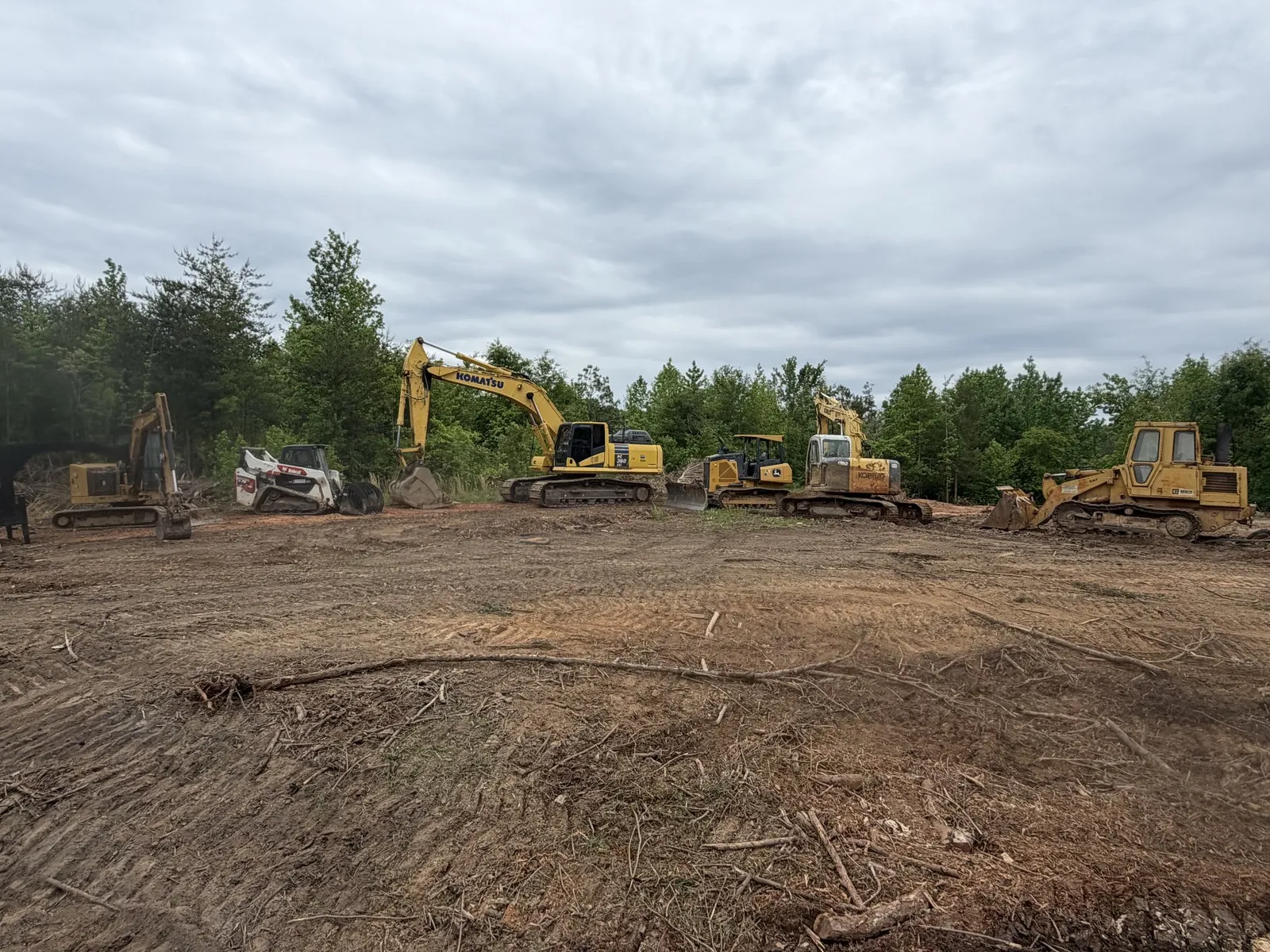
How much does demolition cost in North Carolina?
Demolition in North Carolina runs about $4 to $10 per square foot for a house, or $6,000 to $25,000 for the whole job. A mobile home runs $2,000 to $5,000. A barn runs $2,000 to $7,000 and a shed $200 to $2,000, per 2026 HomeGuide data.
Those are national ranges from published guides, not a quote. What a real job costs comes down to what the building is made of, what sits under it, and how far the debris has to travel. We handle our demolition and haul-off work around Shelby, and every price starts with a free on-site look.
What does it cost to tear down a house, a mobile home, a barn or a shed?
Size and structure type set the starting number. A shed is one machine and a short haul. A house is a permit file, a utility shutdown and a lot of tonnage. HomeGuide’s 2026 demolition pricing puts the four common tear-downs in these ranges, disposal and basic site grading included.
| Structure | Published range |
|---|---|
| House, per square foot | $4-$10 |
| House, 1,500 sq ft | $6,000-$15,000 |
| House, 2,500 sq ft | $10,000-$25,000 |
| Mobile home | $2,000-$5,000 |
| Barn, large wooden | $2,000-$7,000 |
| Shed | $200-$2,000 |
| Shed on a concrete slab | $1,200-$3,500 |
| Detached garage | $1,000-$5,000 |
| Concrete slab foundation | $2,000-$6,000 |
Angi lands close: $6,000 to $25,000, averaging $10,000, or $4 to $17 per square foot. Fixr runs wider on outbuildings at $500 to $3,500 for a shed, $800 to $10,000 for a garage and $1,200 to $25,000 for a barn.
We tear down barns, mobile homes, sheds, garages and other small structures. Full houses are a different trade, and those numbers are here so you know the market before you call anyone.
What does a mobile home tear-down cost, single wide or double wide?
Hometown Demolition puts a mobile home tear-down at $3,000 to $8,000 including disposal, or about $4 to $8 per square foot. The split between a single wide and a double wide accounts for most of that spread, and a permanent foundation underneath pushes it higher.
| Mobile home | Published range |
|---|---|
| Single wide | $3,000-$5,000 |
| Double wide | $5,000-$8,000 |
| Per square foot | $4-$8 |
| Recoverable scrap value | $400-$1,000 |
This comes up a lot around here. Census Bureau five-year estimates for Cleveland County (ACS 2020 to 2024, table B25024) count about 8,000 mobile homes among roughly 44,300 housing units, about 18 percent.
Sort the title out before the machines show up. North Carolina uses NCDMV form MVR-46G to cancel a manufactured home title once the home is permanently attached to land. For a home that is simply torn down we found no published state rule, so start with the Cleveland County tax office.
What moves a demolition price up or down?
Six things do most of the work: square footage, building material, the foundation, site access, hazardous material and the haul. HomeGuide lists the same drivers and notes that clean-up and dump fees climb with the distance to the disposal site.
Foundations swing the number hard. Leaving one in place drops HomeGuide’s figure to $3 to $7 per square foot against $4 to $10 for a full removal. Taking out a basement runs $3 to $5 per square foot, because it turns into an excavation job.
Asbestos is the big one on older buildings. Fixr says a house with significant asbestos costs two to three times a normal demolition, around $10 to $30 per square foot. An inspection is cheap by comparison. HomeGuide puts one at $300 to $900.
Then there is the ground. Cleveland County sits on Piedmont red clay, and Cecil series subsoils run 35 to 70 percent clay. Rock can sit a foot or two down toward the foothills, which slows any machine pulling footings. Shelby takes 47.89 inches of rain a year, and saturated clay is no place for a loaded truck.
Do you need a permit to demolish a building, and what about asbestos?
Yes on the permit. G.S. 160D-1110 names removal or demolition of any building or structure among the work nobody can start without one. In unincorporated Cleveland County it goes through Cleveland County Building Inspections at 1333 Fallston Road in Shelby, 980-484-4997. Inside town limits, use that town’s inspections office.
The county does not publish a demolition permit fee online. HomeGuide puts a standard house demolition permit at $100 to $450 and up, so call for the local number.
Asbestos runs on a separate track. The NC DHHS Health Hazards Control Unit administers the asbestos NESHAP program in every county except Forsyth, Buncombe and Mecklenburg. Its guidance letter says the federal inspection requirement covers commercial and industrial buildings plus residential buildings over four dwelling units, and recommends an inspection on single-family homes too. An NC accredited inspector has to do it.
The notification matters even on a clean building. It has to reach the unit at least 10 working days before work starts, and the letter says a demolition notification is required even if no asbestos was identified. That sits on top of the local permit. Friable or regulated asbestos over 3 square or linear feet must come out first, by accredited workers.
Three more items belong to somebody else. An old septic tank or well goes to the Cleveland County Health Department environmental health division and a licensed septic contractor. The power has to be cut and the meter pulled by the utility, so call Duke Energy first. NC 811 gets at least 3 full working days before anybody digs.
Jobs that disturb more than an acre need an erosion and sedimentation control plan filed with NCDEQ’s Mooresville office 30 days ahead, at $119 per acre. Our post on which land clearing jobs need a permit in North Carolina has that filing in detail.
Where does the debris go after the building comes down?
To the landfill, in a truck, and Cleveland County has rules about which one. The county runs Airport Road Landfill at 1607 Airport Road in Shelby for construction and demolition debris, and Self-McNeilly at 250 Fielding Road in Cherryville for household waste.
The county’s Solid Waste Convenience Site policy, effective March 18, 2025, closes the shortcut. Construction and demolition debris is banned at every county convenience site unless it came from the person’s own primary residence, fits inside one cubic yard per day, and is cut no larger than three feet in any dimension. Anything past that goes to Airport Road. Lettered vehicles count as commercial and are barred outright.
A barn is many cubic yards. The haul is a real line on any quote, which is why our grapple trucks that load and haul debris off do it instead of a trailer and many trips. Fixr prices debris removal at $400 to $800 per truckload.
Metal comes out ahead of the rest. The steel frame and axles under a mobile home go to scrap, and Angi notes steel and clean wood can bring a partial rebate at the recycler.
What happens on the day we tear a building down?
Paperwork first, then machines. We look at the structure, price it, and set a date after the estimate. The permit, the state notification and the utility disconnects all have to land before anything comes down, and those clocks run longer than the tear-down.
On site, excavators and skid steers take the building down from the outside. Nobody works inside a structure that is coming apart. Grapple trucks stage alongside and load as the pile grows, so the debris leaves with the work instead of sitting for a week.
Slabs and footings come up when they are part of the job, and that is where excavation and site prep becomes the bigger half of the day. If a new building is going back on the same footprint, NC Residential Code R506.2 requires the area to be clear of vegetation, topsoil and foreign material first.
Then the ground gets closed up. We backfill and finish with grading and leveling the site flat so water runs off instead of standing in the scar. On red clay that step keeps the spot from turning into a pond by the next storm. That sequence is what tearing down barns, mobile homes and small structures looks like here.
Get a number on your tear-down
Published ranges give you a bracket. The real number comes from someone standing on the site, looking at what the building is made of, what sits under it, and whether a truck can get close. Call (704) 600-8146 or request a free on-site estimate. LDS Solutions is veteran owned and fully insured, and we work about 25 miles around Shelby across Cleveland, Gaston, Lincoln and Rutherford counties.