
What does a driveway culvert cost in North Carolina?
Published cost data puts a driveway culvert install in North Carolina at roughly $865 to $5,800, inside a national range of $800 to $8,000. Homeyou’s cost pages for Hendersonville and Salisbury carry those figures as of September 2026. The pipe is the cheap part of that. Machine time, trench depth and the ditch work around it set the number.
What do published numbers say a culvert costs to install?
Homeyou lists a typical range of $865 to $5,801 in Hendersonville and $868 to $5,821 in Salisbury, both North Carolina towns with hill ground like ours, and its pages note that actual costs still vary. The same source puts the national range at $800 to $8,000. Those totals cover pipe, machine work and backfill on an ordinary residential drive.
Setting pipe, cutting ditch and armoring the outlet is our driveway culvert and ditch work. Here is what published sources show for the pieces of that job.
| Line item | Published range | Source |
|---|---|---|
| Culvert install, national | $800-$8,000 | Homeyou |
| Culvert install, Hendersonville NC | $865-$5,801 | Homeyou |
| Culvert install, Salisbury NC | $868-$5,821 | Homeyou |
| Excavation contractor labor | $120-$150 per hour | Angi |
| Cutting a swale or ditch | $5-$15 per linear foot | HomeGuide |
| Regrading the ground around it | $500-$3,000 | HomeGuide |
Those are market figures, not a quote. A real number comes from looking at the drive and the water, and the estimate is free.
What does the pipe itself cost?
A 20 foot stick of plastic culvert pipe runs about $210 to $800, depending on diameter. Agri Supply lists dual wall pipe at $209.99 for 12 inch and $799.99 for 24 inch. Steel costs more per foot and weighs a lot more. Even at 24 inch, the pipe is a fraction of the installed job.
| Pipe, 20 ft section | Published price | Source |
|---|---|---|
| 12 in dual wall HDPE | $209.99 | Agri Supply |
| 15 in dual wall HDPE | $279.99 | Agri Supply |
| 18 in dual wall HDPE | $439.99 | Agri Supply |
| 24 in dual wall HDPE | $799.99 | Agri Supply |
| 15 in HDPE, per foot | $8.85 | The Waterworks Warehouse |
| 15 in 16 gauge galvanized steel, per foot | $21.75 | The Waterworks Warehouse |
Plastic pipe does not rust and one person can move a 15 inch stick. Galvanized steel is stiffer and a lot heavier. NCDOT’s specification treats both as flexible pipe and bars corrugated steel only in 24 coastal counties, so either one works here.
What size pipe does a driveway need?
Fifteen inches is the floor at a state road in North Carolina, 48 inches is the ceiling, and the pipe has to be at least 20 feet long. Most drives do better one size up from that floor. The Forest Service low volume roads guide says culvert size should be conservative and oversized rather than undersized.
Small pipes plug. Leaves, silt and storm trash fill a 15 inch pipe long before they trouble an 18 or a 24. One customer had us excavate and set two 24 inch pipes so he could reach his land at all.
Depth matters as much as diameter. NCDOT’s standard roadway drawing for pipe culverts sets minimum cover at 12 inches from the top of the pipe, and one foot for all side drain pipe. The same agency keeps heavy equipment off a new pipe until it has 3 feet of cover, which tells you how easily a shallow pipe crushes.
The outlet needs armor. The Forest Service guide says the pipe should reach past the toe of the fill and never discharge onto a fill slope without erosion protection, with graded rip rap as the usual answer. Setting that rock and shaping the channel below the pipe is drainage and erosion control work.
Why does Cleveland County ground change the job?
Red clay and hard rain. Cecil subsoils around Shelby run 35 to 70 percent clay and take in water at about half an inch an hour. A routine two year storm here drops rain near four inches an hour. The clay takes its half inch, and the rest runs downhill toward your drive.
Shelby’s normals run 47.89 inches of rain a year, with about 15 days carrying an inch or more. That is why ditches here fill and why a pipe sized for a dry month fails in July. The old farm terraces on hillsides across the county are the same water fight from a century ago, which is how Cleveland earned the name county of terraces in NCpedia.
Toward the foothills, rock can sit a foot or two down. That turns a trench from an afternoon into a wrestling match, and it shows up in the price. Our post on why gravel driveways wash out in red clay covers the surface side of the same problem.
One rule holds even on a small job. Work that disturbs less than an acre still has to keep its sediment on your property.
Who is responsible for the pipe at a state road?
The property owner furnishes it. North Carolina’s driveway rules say the applicant supplies pipe of the size and type the engineer specifies, and the Department lays and backfills it on request. NCDOT installs a residential driveway pipe at its own expense once the property owner has the pipe on site.
Driveway permits work the same way for most homes. A permit is required before anyone builds a driveway inside state right of way, but connections to residences are normally excluded. NCDOT can pull a residence back in where there is a safety hazard, a highway project, or obvious drainage complications. Applications go to the district engineer, and NCDOT’s driveway permit FAQ says no fee is charged to apply.
Two more rules matter. Where a town or county has its own driveway ordinance, the stricter rule wins, so confirm with Cleveland County before you dig. And a drive may not push water across the pavement or fill the road ditch.
Off the state system, NCDOT has no part in it. On a private road, or a crossing entirely on your own ground, the pipe falls to the property owner or to whoever the road agreement names.
Before any of it, call NC 811. State law wants at least three full working days of notice, and the marks stay good for 28 calendar days.
What moves the price up or down?
Diameter and length set the material cost, and the rest is machine time. Angi puts excavation contractor labor at $120 to $150 an hour, so hours are the meter. A shallow trench in clean clay goes fast. Rock, depth, water standing in the ditch and tight access all add hours.
Replacing an old pipe costs more than setting a new one in open ground. The crushed pipe has to come out, the hole is wider, and the drive over it gets rebuilt. Angi’s guidance is that a rusted or worn culvert is usually replaced rather than patched, and a new one lasts 25 to 50 years.
The ditch is the other variable. If the outlet has nowhere to go, the job grows into ditching and bank work before the pipe means anything. Cutting deep through rock is excavation and trenching, and it prices by the hour.
How does a culvert install go?
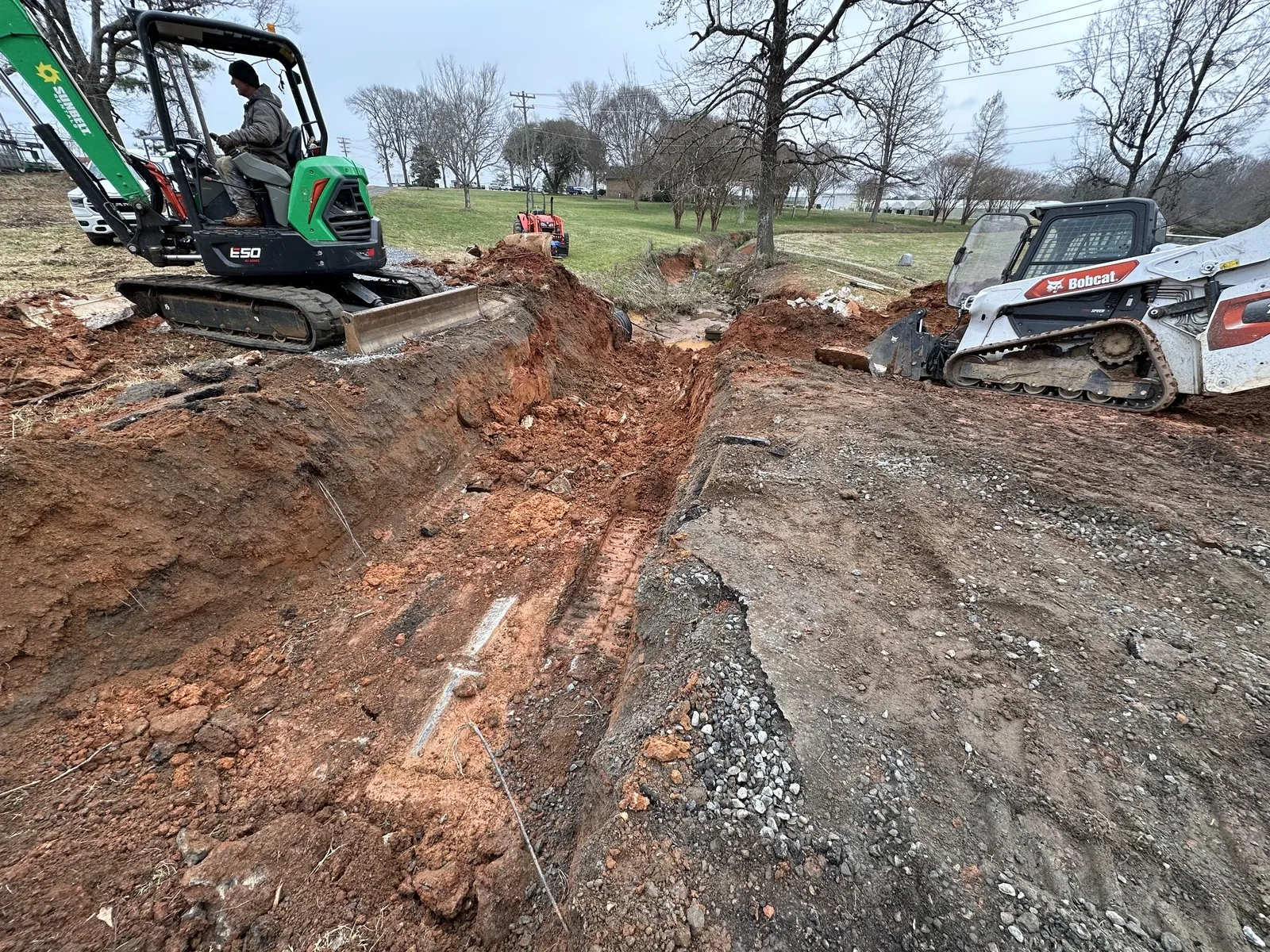
We look at the drive first, then set a date. NC 811 gets called ahead of it. On the day we cut the trench with an excavator, bed the pipe on clean stone at the ditch grade, and backfill in shallow lifts so nothing settles later. NCDOT’s specification caps those lifts at 6 inches loose.
After the pipe is in, we re-cut the ditch so water reaches the inlet, set rip rap at the outlet, and rebuild the crown so the drive sheds water instead of holding it. That last part is gravel driveway grading, and it is what keeps the new pipe from silting up.
The old pipe and whatever came out of the ditch leave with us. Grapple trucks load the crushed pipe and the brush, while clean spoil usually gets spread on site. A drive with a working culvert stops being a yearly repair.
If your drive floods every storm or the old pipe is crushed flat, call (704) 600-8146 or ask for a free on-site estimate. We come look at the drive, the ditch and where the water actually goes, then price the job and set a date. LDS Solutions is veteran owned and based in Shelby, working about 25 miles out across Cleveland, Gaston, Lincoln and Rutherford counties.